Saturday, April 18, 2020

What's new in version 0.6?


Just released a new version the other day for beta testers. The new features you'll see are:

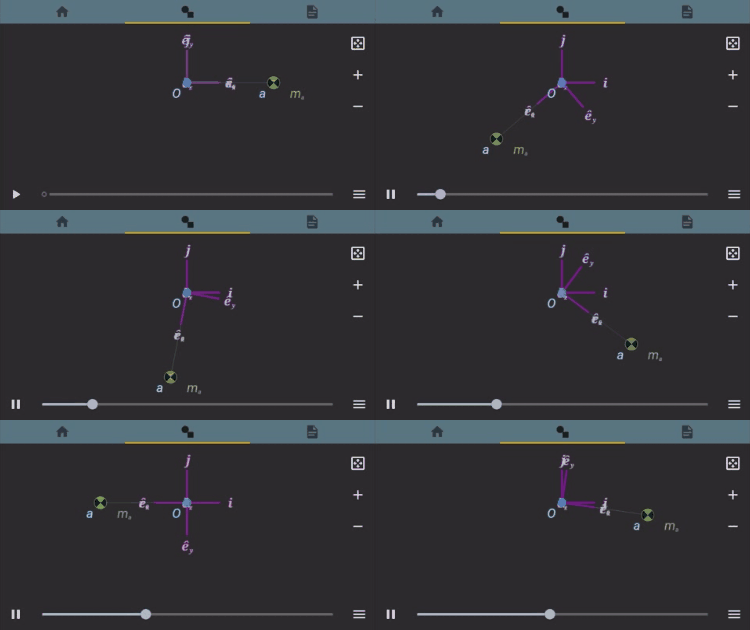
The revolute joint is, of course, a very common component in multibody software, mathematically analogous to a hinge. You can define a rotation axis either as one of your basis vectors, or specify components in multiple basis vectors. The example at the right shows a rotation about the vector 0.707 i + 0.707 k.

Spring graphics now use vector drawing commands, instead of the previous implementation where they were from pre-generated .png images. Should look a bit cleaner, and possibly have a little lower rendering overhead. 

Sunday, March 22, 2020

Feature Showcase - Rigid Body Box

SpinningBox Example
As I mentioned in the blog last week, MOMDYN now includes its first rigid body component, the box. The idea is to create a rectangular prism with uniform density, length, width, and height dimensions. I included the example model "SpinningBox" in the import menu, which is the same as the GIF on this page.

The SpinningBox example is a nice demonstration of dynamic stability of rigid bodies. I can recall my professor showing this with a text book. Grab a book, you can experiment at home. Try holding the book by its two bottom corners, then throw it upwards and try to get it to spin around its horizontal (left-to-right). axis. Chances are, it will start to tumble rather than spin about the single axis. On the other hand, try flipping the book about its other two axes and they should not tumble. A quick explanation of this is here.

In the example, the body y-axis (ey) is set to have the intermediate moment of inertia, and is therefore unstable. The simulation is initiated with a 2.0 rad/sec initial angular velocity about ey, and a smaller rate of 0.2 rad/sec about the body x-axis (ex). You can see the instability, or tumbling, in the GIF; the ey axis starts pointing up and to the left, then the body flips after about a half rotation until ey points down and to the right. After another 2 rotations, the ey axis flips back to its original position.

Suggest experimenting with the example, for instance:
  • In the generalized speeds menu, click the editbutton, make ω_x large and ω_y small
  • In the rigid body box menu, click the edit button, change length, width, or height dimensions
Enjoy.

Monday, March 16, 2020

Whats new in version 0.5?

As of yesterday (3/15) I have submitted a new version of momdyn to App Store Connect for the Test Flight beta, and to the Google Play Store for alpha testing. Thats right, finally compiled a version for Android! Besides that, here is a quick summary of whats new in this release:
  • New solvers, including with adaptive step sizing
  • New rigid body box
  • Simulation status is displayed with completion ratio and time step
  • Report view is split into pages for each component type

Monday, January 13, 2020

Mass-spring-damper

Mass-Spring-Damper Simulation

Introduction 


The mass-spring-damper problem is the simplest problem used in analysis of linear vibration. This example shows how to use the "classic" interface in MOMDYN to define the kinematics of the oscillator, and simulate its free vibration response.


Procedure

Using the classic interface, you will specify system constants (mass, stiffness, damping, and equilibrium length of the spring), a single generalized coordinate (vertical position), and use these to create a vector from the origin to the mass, a point, a particle, and the spring-damper. At completion, you will simulate the oscillating mass and visualize it's dynamics


Saturday, January 11, 2020

Simple Pendulum

Introduction

The single-degree-of-freedom pendulum problem is likely the most common problem used to teach principles of mechanical engineering dynamics. This example shows how to use the "classic" interface in MOMDYN to define the kinematics of the pendulum problem, and simulate its response to a specified initial angle and angular velocity condition.