Saturday, January 28, 2023

Progress on MOMDYN 2 for iOS

As I mentioned in my last post, the last few months have been dedicated towards porting the iOS version of Mobile Multibody Dynamics to native Swift, with SwiftUI interface and SceneKit for 3D graphics. I'm happy to say that its getting close! Close enough that I have a beta test available that you can try today, and here's the link:

https://testflight.apple.com/join/xLu2Ose2

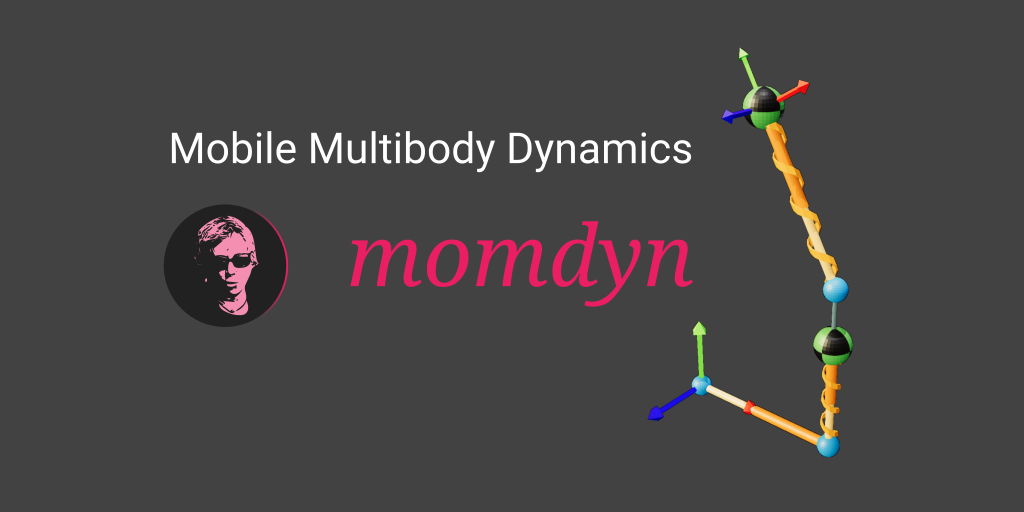
For a little eye candy, and to show off the new 3D graphics engine, here's a simple string of masses and springs. My selling point for MOMDYN has always been that its disconnected from a workstation, doesn't require internet, etc, so its there whenever you get the creative urge. This is that in action.


Lastly, I've posted a couple of videos to the Mobile Multibody Dynamics Youtube page. Here is a video showing the built-in example models.


And here is a video showing the user interface to build up a double pendulum.


Looking forward to having this release live on the App Store soon!


Sunday, October 2, 2022

What's up with MOMDYN? Brushing up on native iOS, and Unity.

While pace has slowed on new Mobile Multibody Dynamics releases since MOMDYN 2.0 on Android, rest assured, the show goes on. There will be a version 2.0 for iOS, using native SwiftUI and SceneKit ... soon. in the meantime, I've done some cool stuff like this Euler angle rotation code:


That one is up on GitHub. 

Friday, June 17, 2022

Happy Birthday to me! 1000 active installs on Android, and new apps coming soon.


Not a whole lot is new as far as the MOMDYN app goes, mostly squashing bugs on Android, and slowly bringing the native iOS version online. I do have one cool thing, which is today is the first day that there have been 1000 active devices with MOMDYN installed, and its my birthday, how `bout that?

Monday, April 11, 2022

Double Pendulum Simulation Video

Check out the brand new video on our YouTube page showing a simulation of a double pendulum using two rigid links. The kinematics are defined using two revolute joints for rotation, and rigid translations to define the centers of rotation. Double pendulums are famous for being chaotic, a small change in initial conditions lead to a large change in response. Here, we show this by gradually increasing the initial angle, where the pendulum motion starts out as fairly simple and repeated oscillation, it becomes more and more disorderly as the initial angle increases, with the second link eventually doing complete flips relative to the first link. Learn to build a model like the animation below, and video after the jump.


Sunday, January 23, 2022

Ship It! Version 2.0 is rolling out, and new vibration tutorial


As I've mentioned in the last two posts, MOMDYN is getting its biggest upgrade yet, with version 2.0 for Android implementing a fully rebuilt, native interface. We will be rolling out to all new and existing users in the next week. In the meantime, check out this tutorial on Youtube to create a mass-spring-damper system, typical of vibration analysis (after the jump).

Tuesday, January 18, 2022

Version 2.0 beta test is live for Android users

As I posted a couple months ago, I have been hard at work re-building the Android version of Mobile Multibody Dynamics. Well, I'm happy to say that the update is just about 98% done, and ready to go for beta testers! If you are an Android user, you can opt into the beta test by visiting https://play.google.com/apps/testing/com.badeyedea.momdyn. Below image is from the updated tutorial video for a simple pendulum, and you can catch a Youtube video showing how to create this model after the jump.

Monday, November 8, 2021

Version 2.0 is on the way

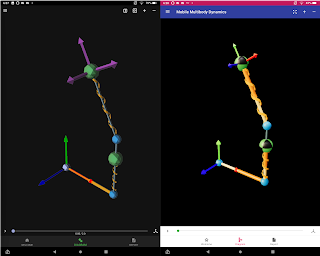
While I haven't been very active on the MOMDYN blog or social media lately, I'm glad to report I've been *very* active on the development side, and am happy to announce the biggest update yet: Version 2.0 for Android! So what makes this the biggest update yet? How about a completely overhauled and updated user interface. You can see an example in the image below; crisper graphics, brighter colors, more familiar design. On the left, the currently released version 1.7, on the right, the upcoming version 2.0.


As for the technical details, the interface has been re-written to use native Kotlin, heavily leveraging Material Design elements. This change will make everything feel a lot more natural, and performance more responsive and crash-free. Chaquopy is used to load the Python-based modeling engine. Lastly, in my favorite trick, the Google Filament physics-based-rendering engine is used for the 3D graphics. Want to get in on the beta testing (soon), drop me an email. I think you'll like it!